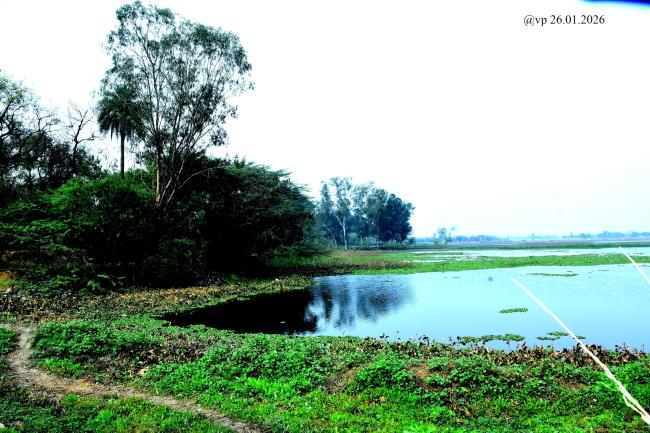
The Sauj Jheel located in Karhal tehsil of Mainpuri district in the State of Uttar Pradesh, is a shallow water body in the Ganges floodplain
landscapes. It is located nearly 3 km from the Saman Bird Sanctuary. The Jheel is surrounded by agricultural fields and human settlements. The
major source of water is agricultural run-off and precipitation. Sauj Jheel provides diverse aquatic habitat especially for the migratory and
resident water birds. It is home to threatened species, which includes two (02) endangered and One (01) vulnerable reptile species and two
(02) vulnerable species of water birds. The Site has rich biodiversity, which includes 43 species of water birds, 19 species of fishes, 07
species of reptiles. The site regularly support more than 30,000 water birds. Sauj Jheel is a significant wintering ground for Great White Pelican
(Pelecanus onocrotalus),Greylag goose (Anser anser), Bar headed goose (Anser indicus) and Ruddy Shelduck (Tadorna ferruginea). Also,
large congregation of of Sarus crane (Grus Antigone) , Painted Stork (Mycteria leucocephala), Asian Openbill (Anastomus oscitans) and Blackheaded Ibis (Threskiornis melanocephalus). It has been identified as an Important Bird Area (IBA) in Uttar Pradesh (IN-UP-20) based on criteria
A1 (threatened species) and A4iii (>20000 waterbirds) of Birdlife International. Grazing activities and catching fish by local people is the main
threat for the Jheel. Mainpuri Social Forestry Division is planning to implement management action plan to resolve or mitigate these threats
which includes ban on entry, grazing, fishing in critical bird nesting and breeding areas with limited and regulated access and traditional use
only in outer region. As part of habitat development, plantation drive is proposed around the Jheel. Thorny plant species such as Prosopis
juliflora and Acacia nilotica will be sown to create a natural barrier and restrict cattle entry into the wetland. Specific measures include deploying
Suraksha Shramik (Cattle Guards) to regularly monitor and restrict livestock movement, along with a complete ban on fishing during peak fish
breeding and migratory bird seasons (monsoon and winter), followed by prohibition of fine-mesh nets, chemical poisoning, and over-harvesting
of fingerlings, while involving local villagers in daily monitoring and patrolling.